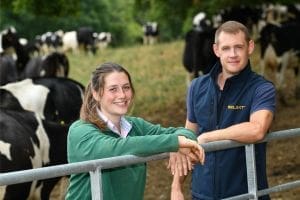
A firm belief in the value of a team is what drives the management at Stocken Farm, in Buckinghamshire, and is the foundation of an impressively well-managed herd health program.
With over 17 staff, many working different hours and days, Charlotte West, who farms with her brother, Robert, and parents, Richard and Maxine, oversees the rota and staff training for their 450-cow Holstien Friesian herd at Stocken Farm in Buckinghamshire. “With a few exceptions, I train everyone in every role,” explains Charlotte. “This ensures that we all understand the challenges of every job on the farm, how each task fits into the overall running of the herd and cover is easily available if we have someone off work.”
Charlotte believes it makes the job more interesting, and because people understand what is being done and why, they are more likely to take ownership of the task at hand.
One aspect that has been particularly successful is herd health. All team members are trained in identifying sick cows and treatment protocols. “Wherever that animal is on the farm, from cubicle shed, collecting yard or the parlour, someone will be able to spot the signs of illness and report to the correct person.”
This has been acutely important this year, where heat stress has tested all the herd, especially sick and fresh cows.
“As a business, our goal is to have systems in place to prevent health issues. It’s an area of animal care we have really focussed on in recent years and have seen some good results,” she explains.
Each morning, the rota allocates a member of the team to the herd health check. The fresh cow group and heifer group all benefit from headlocks, and using the Cow Manager app, animals that have been identified with reduced intakes are checked. “Having this dedicated person ensures every animal of concern is looked at. You want to see cows’ intakes on an upward protectory after calving, so any animals not achieving this automatically go on a protocol.”(see Box)
Charlotte works closely with farm vet Sam Potter, from the Hook Norton Vet Group, who offers advice and training to the team. Together they have developed a comprehensive guide to using hydration products in the herd, particularly cows that are seeing reduced rumination in early lactation.
Charlotte explains, “We had been drenching sick cows for many years, but around two years ago, we really focussed on how we use the Selekt system and the formulae we were using for a targeted approach. We now have four different protocols; restore, off feed, fresh and antacid so the most suitable action is taken. So, for example, every 3rd lactation cow or over gets a fresh cow drench as we have found the older cows are more prone to health issues and this acts as a preventative measure.
“Hydration is everything,” she says. “Quite often a drench will save a sick cow. It fills the rumen and with the right formulae, the yeast can stimulate the bugs in the rumen and turn them around. I’m in no doubt this action has prevented DA’s in our herd, which we rarely see now.”
“If a cow has a temp of 40 or over, she is likely to have reduced feed and water intakes so she will automatically receive an off-feed formulae drench alongside the correct treatment. It’s all about getting the right formulae to encourage appetites and that rumen working.”
Although this is a year-round approach to animal health, it has additional benefits in the hot weather, when dehydration maybe more severe. The herd currently averages 11,870 litres, milked 3x/day, and so water demand is high. “Cows can quickly become dehydrated, so this system helps us avoid health problems,” she says.
Farm vet, Sam Potter, from Hook Norton Veterinary Group, adds, “Calving and illness are high risk events that can lead to dehydration in dairy cows. Add to that, heat stress or a high yield, and that animal can be severely challenged to drink enough water to meet its demands, which, if not met, can lead to many health issues and even death.
“Stomach pumping is a very effective and quick way to supplement the cow’s daily fluid requirements, and one that is routinely used at Stocken Farm and targeted to each individual cows’ needs. For example, the fresh cow is given a mixture that provides additional calcium and yeasts to promote normal rumen function and prevent milk fever and ketosis. Sick cows are given an electrolyte sachet that also replaces sodium, potassium and chloride ions. Added dextrose can see a quick response in energy, resulting in eating and drinking. This aids recovery and therefore results in the animal achieving her potential quicker than if she had a slower improvement.”
Sam continues, “Early intervention with fluid therapy is a positive, and practical, task that can be done on any farm to reduce the risk of metabolic disease and improve recovery of sick and fresh cows. I’ve worked a lot with Charlotte and the team to establish a system that everyone can use and is effective. With targeted therapies, the farm has seen a successful outcome which will see extended benefits in terms of yield, fertility and longevity.”
In the future, Charlotte will continue to focus on the detail and benefits of the specific formulae and ensure the team are all competent in their roles.” I’m so proud of the team we have. They’re all so receptive to learning new skills and have genuine compassion for our herd. It’s a real collaboration to do the best for the animals in our care,” she concludes.
COW DRENCH PROTOCOLS
- Fresh cow formulae Fresh calvers 3rd lactation or over
- Any milking animal over 24 hours after calving that intakes are not increasing
- Off feed Sick animals to promote eating
- Restore Follow up to Off Feed if intakes not increasing (x2)
- Antacid Acidosis