
Sheep grazing on moorland emit lower levels of both methane and carbon dioxide compared to those foraging on grassland lower down in the valley, a study carried out in the Yorkshire Dales National Park has shown.
The Forage for CH4nge project – funded by Innovate UK – brought together farmers and scientists in a bid to better understand how traditional breeds and different pastures can help reduce the environmental impact of sheep farming.
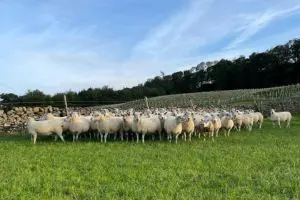
Led by local Wensleydale farmer and founding member of SWEF Adrian Thornton-Berry, in collaboration with the Game & Wildlife Conservation Trust (GWCT), UK Agri-Tech Centre, Scotland’s Rural College (SRUC), the National Sheep Association (NSA), and the Yorkshire Agricultural Society, it measured the methane emissions of native Swaledale sheep and half-bred Texel-cross sheep grazing on different forages in the upland landscape.
The study found that the native Swaledale ewes produced less methane than the commercial Texel-crosses, due to their smaller body size. Once you adjusted methane emissions taking that weight difference into account, there was little difference between the two types.
Tests did show that ewes of both breeds, foraging on improved grassland (treated, seeded and/or fertilised) produced more methane per day, compared to those that foraged on herb-rich natural grassland (untreated for 30 years) or moorland.
Native Swaledale ewes also produced less carbon dioxide than crossbreds, even after adjusting for weight, and ewes of both types produced more carbon dioxide when foraging on improved and herb-rich grasslands, compared to on moorland.
The three types of forage the study focused on were:
- Improved grassland – grass with modern ryegrass leys (used to maximise yield in livestock farming) in the meadows.
- Herb-rich pastures – grass which has had no fertiliser or FYM (manure spreading) for last 30 years (i.e not improved)
- Moorland forage – unimproved permanent forage of rough grass, bilberry, heather and other shrubs higher up in the hills (regenerating dry heath on the high marginal land and moorland).
How it was measured
The study used 120 sheep – 60 of each breed (Swaledales and Texel-crosses) – split into three groups of 40 – grazing either improved, herb-rich or regenerating moorland forage.
They were brought in twice, two weeks apart, and methane emissions for individual sheep measured inside mobile Portable Accumulation Chambers (PAC) on Adrian’s farm in Swinithwaite, near Leyburn. Each sheep was placed in one of 12 pods onboard the PAC trailer for 50 minutes while being carefully monitored, and its methane and CO2 emissions measured. Other measurements such as weight and body condition score were collected before testing. Careful stock handling kept stress levels to a minimum. After testing sheep were returned to their fields to graze.
Adrian Thornton-Berry says: “The heritage aspects and cultural value of these Swaledale sheep are really important. We want to find a way to preserve the breed while farming these sensitive areas in the best way we can to preserve them for future generations.
“Essentially, Forage for CH4nge is all about showing that farmers are key to a sustainable future for Britain’s uplands, utilising our native-breed sheep to deliver environmental benefits to support both our sensitive habitats, biodiversity and to help mitigate climate change.”
Ellie Raynor, GWCT ecologist and working on the project, says: “The ultimate aim is to find a way to support upland sheep farmers and help them improve productivity, efficiency and financial resilience at the same time.
“If farmers are aware of how these breeds interact with the sensitive habitats in this precious landscape, they can look for external support to financially underpin their businesses. By quantifying the environmental impact of the different breeds, there is potential to promote the breeds which produce lower levels of methane and CO2.”
‘Moorlands act as methane sinks’
Agriculture contributes 12% of the UK’s greenhouse gas (GHG) emissions with 50% of this from livestock. Methane is a potent GHG, therefore a key priority for the sector to focus mitigations on.
Ellie Roberts, Niab,’s Forage Crop Specialist who reviewed the results of forage plant species identified at each site, says: “Not only do sheep grazing on ericaceous moorland plants and forage species containing condensed tannins reduceenteric methane by up to 50%, well-aerated areas of moorland and upland grassland soils act as ‘methane sinks’, providing the right conditions for methanotrophic bacteria in the soil to break methane down.
“As Swaledale sheep are well adapted to graze on moorland and in upland environments, they play a critical role in maintaining these habitats and their function as methane sinks, making moorland native Swaledale protein very climate friendly.”
Nicola Lambe, from Scotland’s Rural College, who produced the full scientific report for the study, says: “This research project has given us the first opportunity to compare methane emissions from ewes grazing different UK upland vegetation types.
“One thing that we weren’t able to test within this project was whether the ewes producing more methane were doing so because they were eating more. It would be really interesting to be able to look at methane per kilogram of dry matter intake in a future project.”
Michael Priestley, Policy Manager for the National Sheep Association (NSA) says: ”This study lays a foundation for future study projects. The development of a method for comparing emissions from sheep breeds grazing in various natural habitats, will help provide a new framework to measure carbon footprint and help define sustainable and resilient future farm systems.
“The agricultural sector has committed to trying to reach net zero by 2040, so reducing methane from our sheep and cattle will be a part of achieving that.
“Sheep farming recognises its role in climate change abatement and as well as genetics and rumen microbiology, the industry is working on nutrition, nutrient management, flock health and efficiency, and fossil fuel dependency to minimise emissions from sheep flocks while continuing to produce highly nutritious food to enhance food security.”
The study secured funding from the Department for Environmental Food and Rural Affairs (Defra) and UKRI as part of the Research Starter Programme.